
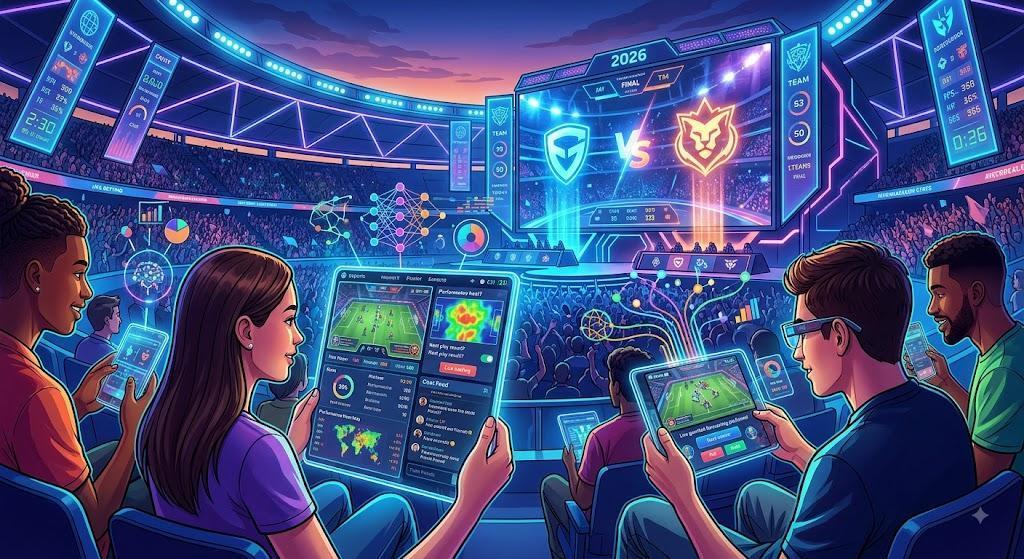
The Living Room TV is Just a Dumb Monitor Now
Your flat-screen television is basically just an expensive lamp at this point. Look at the Super Bowl LX data for proof. Linear feeds bled out this year, dropping from a historical 69 percent base to a rather pathetic 61 percent. Fans did not actually stop watching the game. They simply migrated their primary attention to the glass in their hands. While 90 percent of viewers still kept a large screen illuminated in the background, internet-connected viewing swallowed 49 percent of the market share for the first time in history. The primary broadcast feed is now just ambient light.
Corporate ad dollars followed this exact behavioral shift with ruthless efficiency. Commercial returns on interactive digital platforms are currently yielding three times higher ROI than standard OTT networks, and they are vastly outperforming legacy television. Barely half of younger viewers—specifically 58 percent of the Gen Z and Millennial cohort—can stomach a live game without digging into their pockets for a mobile device. That specific behavioral tic forced the entire broadcast industry to rip out its backend plumbing. Nobody wants to pay a premium for commercials when the audience is staring at their laps. You have to put the monetization exactly where their thumbs are.
Milliseconds and Market Arbitrage: Killing the Spoiler Effect
Legacy protocols used to rely on a comfortable fifteen-second buffer. HTTP Live Streaming (HLS) and MPEG-DASH were brilliant for scaling video across global servers a decade ago, but they introduced a devastating "spoiler effect." You cannot run a live microbetting market when a push notification beats the visual broadcast by a dozen seconds. The catch with sub-second alternatives like WebRTC was always the financial ruin they caused at scale. A million concurrent viewers on WebRTC requires complex cascades of Selective Forwarding Units (SFUs); a scaling nightmare that drives cloud compute costs through the absolute roof. Frankly, nobody wanted to foot that massive egress bill just to save a few seconds of delay.
The industry finally collapsed this streaming trilemma by adopting Media over QUIC (MoQ). This transport protocol leverages multiplexed UDP streams to push video and raw data down the exact same pipe with roughly 300 milliseconds of latency. An event organizer can now sync 4K video frames perfectly with player statistics, injury telemetry, and live polling data. This sub-second synchronization is the absolute backbone of modern monetization.
The microbetting sector now accounts for a massive chunk of digital wagering, and it relies entirely on this flawless synchronicity. A viewer can watch a pitch in a baseball game and instantly wager on the speed of the next throw before the pitcher even winds up. Network executives figured out they can use gamified forecasting platforms as a massive vacuum to pull viewers out of random social media threads. The goal is simple: lock the viewer inside a proprietary Owned and Operated (O&O) app. Every second spent inside that walled garden generates raw behavioral metrics, which spikes the lifetime value of that specific user to absurd heights. The math is entirely unforgiving. Any network missing that strict sub-second window is basically donating their revenue to offshore bookies. Lag kills the entire business model. The second a video feed stutters during a crucial play, frustrated users close the application; you lose those daily active metrics instantly.
Slicing the Spectrum: Why Your Stadium WiFi Finally Works
Eighty thousand fans packed into a concrete stadium bowl used to guarantee a total cellular blackout. The reality is much different today thanks to the aggressive rollout of 5G-Advanced under 3GPP Release 18. Telecom engineers can now partition the spectrum. One specific lane, known as Enhanced Mobile Broadband, exists entirely to jam 4K video straight into your handset. A completely separate, ultra-reliable channel runs quietly underneath it to handle the split-second telemetry bleeding off the players' wearables.
The backend handles load balancing without any human operators in the loop. Imagine the halftime show kicks off and everyone opens their AR apps at once; the software defined network instantly notices the crunch and funnels emergency bandwidth directly into those specific XR pipes. Those specific flows operate with a latency budget of less than one millisecond, ensuring zero lag between the physical world and the digital overlay.
Telecom capital expenditures are already bleeding into early 6G test networks to completely reshape the physical limits of connectivity. These next-generation networks operate on terahertz (THz) frequency bands and utilize Intelligent Reflecting Surfaces installed throughout the stadium architecture. The hardware literally bounces signals around concrete pillars and human bodies to prevent dropped packets. This raw bandwidth enables the transmission of uncompressed volumetric video directly to mobile devices, rendering physical obstructions completely irrelevant to the broadcast experience.
Frying the Silicon: How NPUs Prevented a Hardware Meltdown
Force a standard smartphone CPU to crunch visual telemetry for an entire NFL game. The phone shell heats up to nearly 50 degrees Celsius within minutes. The OS immediately throttles the hardware to prevent a fire, which ruins the AR experience completely. The industry avoided a mass hardware meltdown by shifting the processing burden away from the central chip entirely.
Survival in this hardware ecosystem requires offloading that math to a dedicated Neural Processing Unit. Chips like the latest Snapdragon Hexagon or Apple's silicon can hammer out 50 Trillion Operations Per Second. Best of all, they do it while barely sipping from the battery reserve. Software developers specifically optimize their AI models for these chips through hardware-aware quantization. Engineers deliberately crush these AI models down from bulky 32-bit formats into lean 8-bit integers. You lose a microscopic sliver of accuracy, but the speed gains are exponential. Right now, every chip designer on the planet is fighting to cram more of those operations into smaller physical dies. Apple and Qualcomm are effectively dictating the pace of media innovation by deciding exactly how much heat a consumer's hands can tolerate.
This compression drastically reduces the memory bandwidth required to pull data from the device's RAM. Local hardware cuts the processing delay for visual transformers down to under five milliseconds. Hold your camera up during a chaotic mayoral debate; the software processes live fact-checks and overlays polling numbers directly onto the stage in real time. Should the handset actually approach its thermal limit, smart edge protocols quietly kick the heavy mathematical lifting back up to the stadium's local server racks.
Ghost Players and the Death of the Passive Feed
Elite optical tracking systems provide the raw intelligence that makes these second-screen overlays possible. Infrastructure like Hawk-Eye's SkeleTRACK maps dozens of skeletal nodes on every physical player at fifty frames per second. This biometric data flows through the MoQ relays and hits the viewer's device instantly, creating a perfect mathematical mirror of the physical event.
Artificial intelligence engines like WSC Sports ingest this spatial data to automatically generate personalized narratives on the fly. A fan tracking a specific underdog candidate in a local election, or a single rookie in a basketball game, receives a completely unique, vertically optimized highlight reel cut by an AI within seconds of the event occurring. The primary screen shows the generic, unified story designed for the masses. The glass in the viewer's hand shows their highly localized, financially motivated reality.
Political campaigns are quietly adopting this exact architecture for debate nights. Voters do not just watch candidates argue anymore. Viewers use their secondary screens to track real-time biometrics, live fact-checking overlays, and micro-donations tied to specific policy drops. The ecosystem turns a standard civic event into a high-stakes, interactive data exchange.
We have fundamentally re-architected media consumption from the ground up. The broadcast feed is no longer a finished product you simply sit back and watch. It is a live, malleable dataset you manipulate in real-time to fit your personal wagers and social feeds. Anyone still trying to sell a passive, one-way television feed in this ecosystem is already out of business.