The visual economy of digital publishing has reached a saturation point where the cost of generic imagery is no longer just financial; it is a tax on brand authority. For years, editorial teams relied on a binary choice: expensive custom photography or the sterile, overused corridors of stock photo libraries. When generative AI first arrived, it promised a third path, yet early adopters quickly hit a ceiling. The images were often too “dreamlike” or lacked the anatomical and structural discipline required for professional layouts.
We are now moving into a second phase of generative media. The conversation has shifted from “can an AI make a picture?” to “can an AI produce a specific asset that adheres to a brand’s visual grammar?” Shifting from a placeholder mentality to a high-fidelity production workflow requires more than just a prompt box; it requires a model architecture designed for precision and a workspace that respects the iterative nature of design.
The High Cost of Generic Imagery in Digital Publishing
Stock photography served its purpose in an era of lower-density content, but in a landscape where every article competes with high-budget social video and immersive media, generic assets act as a “bounce” signal. When a reader sees a stock image they have encountered on three other blogs that week, the perceived value of the surrounding text drops. The same is increasingly true for “low-effort” AI generations—images that feel floaty, over-saturated, or logically inconsistent.
The hidden “time-tax” of using basic generative tools often goes uncalculated. A creative lead might spend forty minutes wrestling with a prompt to get a specific composition, only to settle for something “close enough.” This lack of stylistic control creates an editorial gap—a space where the visual narrative of a publication feels disconnected from its written voice. For a professional outlet, the goal isn’t just an image; it is an asset that feels intentional.
The friction is most visible when a publisher needs to maintain consistency across a multi-part series or an entire campaign. If the first article features a high-contrast noir aesthetic and the second looks like a bright corporate 3D render, the brand identity fractures. Traditional generative tools often lack the “memory” or structural weight to repeat styles without heavy manual intervention.
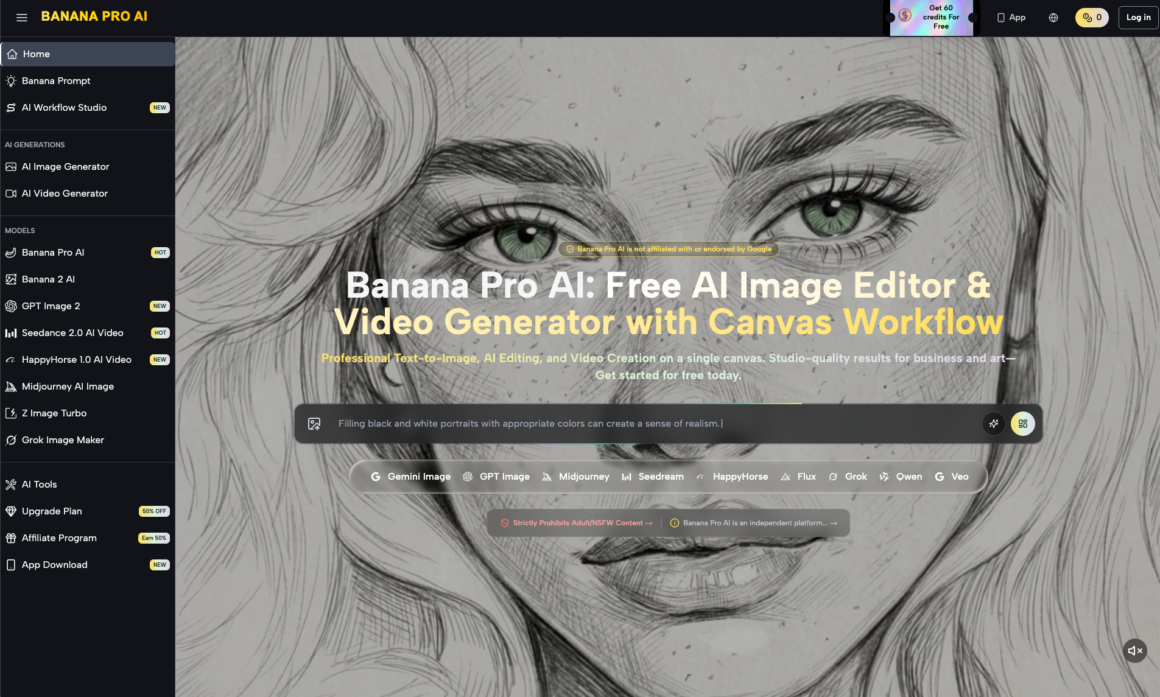
Engineering Precision via Banana Pro AI
Closing the editorial gap requires a model that understands the nuance of a layout. While general-purpose models are trained to be “pleasing,” specialized engines like the Nano Banana AI are optimized for prompt adherence and structural logic. For a creator, this means the difference between a tool that guesses and a tool that follows instructions.
In a practical editorial workflow, this precision manifests in how complex prompts are parsed. If an editor requires a specific top-down view of a cluttered desk with a 1970s aesthetic, the model must maintain the physics of the objects and the specific color grading of that era without introducing the “hallucinated” textures common in smaller, unrefined models. Banana Pro AI provides the backend infrastructure to handle these higher-compute requirements, ensuring that the output remains sharp enough for high-resolution displays.
One of the significant advantages of using Nano Banana AI is its ability to interpret spatial relationships. In traditional stock sourcing, you are at the mercy of the photographer’s original frame. In a generative workflow, you define the frame. If you need negative space on the left for a headline overlay, you can dictate that in the prompt. This level of intentionality is what separates a mere “picture” from a functional “editorial asset.”
From Static Hero Images to Dynamic Canvas Workflows
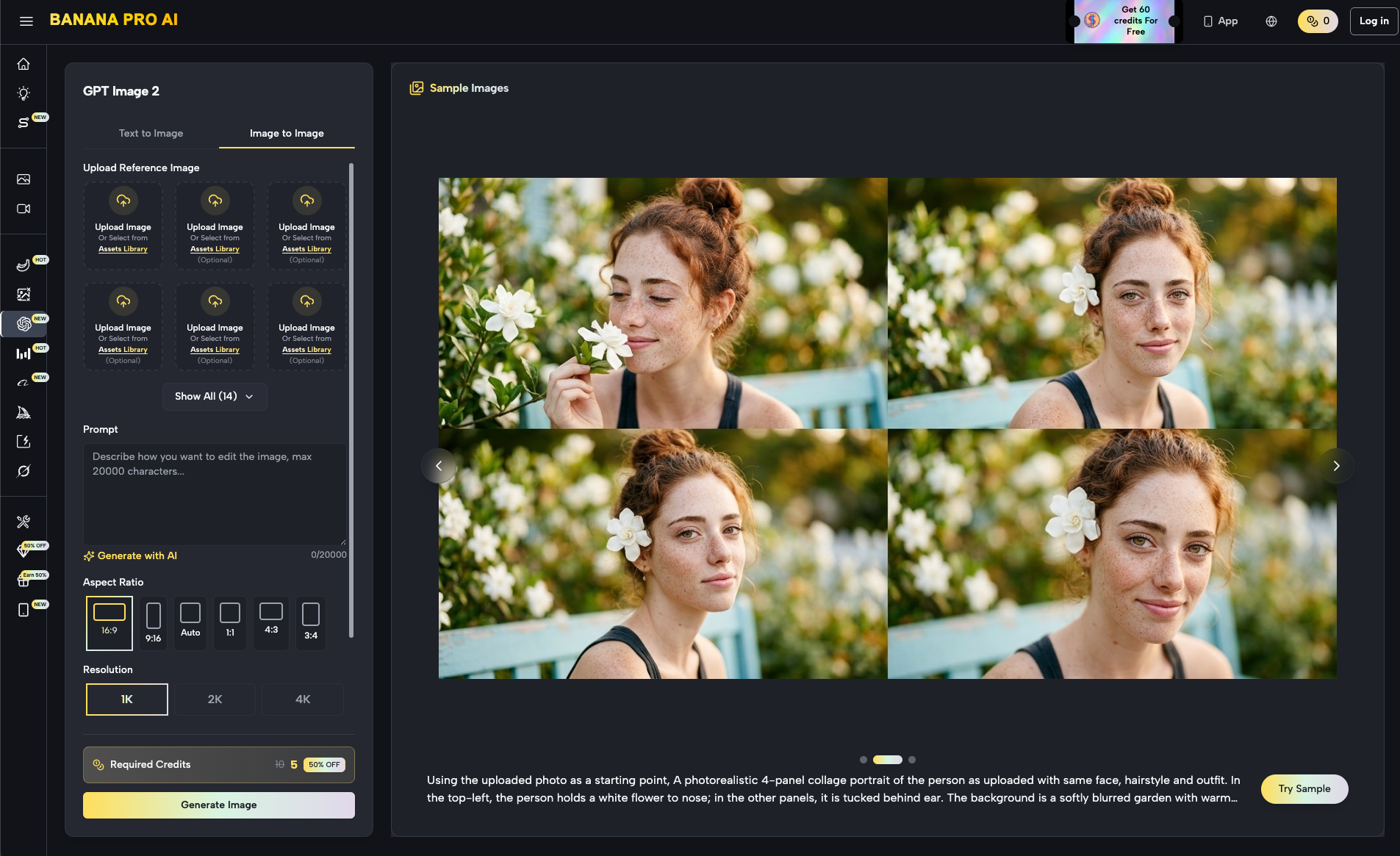
A single generation is rarely the end of the creative process. Professional designers know that the first draft is just a foundation. This is where the Nano Banana Pro environment changes the utility of the tool. Instead of a linear “prompt and download” cycle, a canvas-based workflow allows editors to treat the AI output as a living document.
The canvas allows for the expansion of concepts. If a hero image is generated but needs more “breathing room” for a specific web layout, out-painting or expanding the borders becomes a task of seconds rather than hours in traditional editing software. This is a critical feature of Nano Banana Pro, as it integrates the generation process with basic spatial editing. You are no longer stuck with the initial aspect ratio or the specific crop the AI decided on.
Furthermore, the transition from static to motion is becoming a standard requirement for digital publishing. Turning a high-fidelity image into a social teaser or a background video header is a high-value move for engagement. By leveraging image-to-video pipelines within the same ecosystem, a publication can maintain visual continuity from the article header to the Instagram Story promoting it. Banana Pro facilitates this by allowing the seeds of the original image to inform the motion, ensuring the video doesn’t “break” the style established in the static version.
The Hard Limits of Current Generative Fidelity
Despite the rapid advancement of these models, it is essential to maintain a realistic perspective on what generative AI can and cannot do. We are currently in a state of high capability but limited “perfect” automation.
One primary limitation is typographical rendering. While specialized models are getting better at generating text within images, they still struggle with complex brand fonts or specific, long-string copy. If your editorial asset requires a specific headline embedded in the 3D space of the image, you will likely still need a manual pass in a vector tool to ensure the kerning and spelling are perfect. There is a persistent uncertainty when it comes to rendering precise text that prevents these tools from being truly “one-click” for finished ad copy.
Another area of caution is hyper-specific spatial physics. If an image requires multiple human figures interacting in a very specific, intertwined way—such as a specific surgical procedure or a complex sporting maneuver—the AI may still produce anatomical errors or “merge” objects in a way that looks unprofessional. Nano Banana handles these better than most, but the need for human oversight remains absolute. One cannot safely conclude that AI can replace the role of an art director; rather, it moves the art director from the role of “maker” to “curator and polisher.”
Integrating Generative Pipelines into Editorial Calendars
To move beyond the experimental phase, content teams must treat generative tools as a structured part of their pipeline rather than a novelty. This starts with the creation of a “Prompt Style Guide.” Much like a brand has a guide for its written tone and color palette, it should have a library of vetted prompt structures that utilize the Nano Banana models to produce consistent results.
For example, a tech publication might decide that all their featured images should use a “blueprint-minimalist” style with a specific hex code for accents. By standardizing these parameters, they reduce the creative fatigue that comes from starting every generation from scratch. Banana AI excels here because its consistency allows these templates to work reliably over time, rather than producing wild variations with every update.
The ROI of this shift is found in the compression of the production cycle. A process that once involved searching a database, purchasing a license, and then color-correcting the image in Photoshop can now be condensed into a five-minute session within the Nano Banana Pro canvas. The result is an asset that is unique to the brand, perfectly sized for the layout, and ready for multi-platform distribution.
Ultimately, the goal of using Banana Pro AI is not to flood the internet with more content, but to increase the density of quality in the content we already produce. By moving away from the “placeholder” stock image and toward high-fidelity, contextual assets, publishers can reclaim their visual identity and provide a more immersive experience for their audience. The tools have matured; the next step is for the workflows to follow suit.