

Retribution looks simple on paper: build Holy Power, spend it on big hits, repeat. Then you step into a raid or a higher key and realize a ret paladin is also a source of group utility, a cooldown manager and a player who has to time burst around what the encounter is doing. This article covers where players lose the most damage, what to check before you queue, and how to think about the spec beyond the rotation.
Why Ret Paladin Is Harder Than It Looks
The core loop is easy to learn. The difficulty shows up on three levels.
Resource management. Holy Power is capped, and overcapping wastes damage just as starving yourself does. If you are sitting at the cap and still pressing generators, you are throwing value away.
Burst windows. Your major cooldown (Avenging Wrath or Crusade, depending on the talent setup is worth far more when your other abilities are lined up behind it. Pressing it the moment it comes off cooldown is not always correct.
Utility. Blessing of Freedom, Blessing of Protection, Hand of Hindrance, Lay on Hands, Hammer of Justice and Rebuke give the class a real team role. A good paladin wins keys with more than damage.
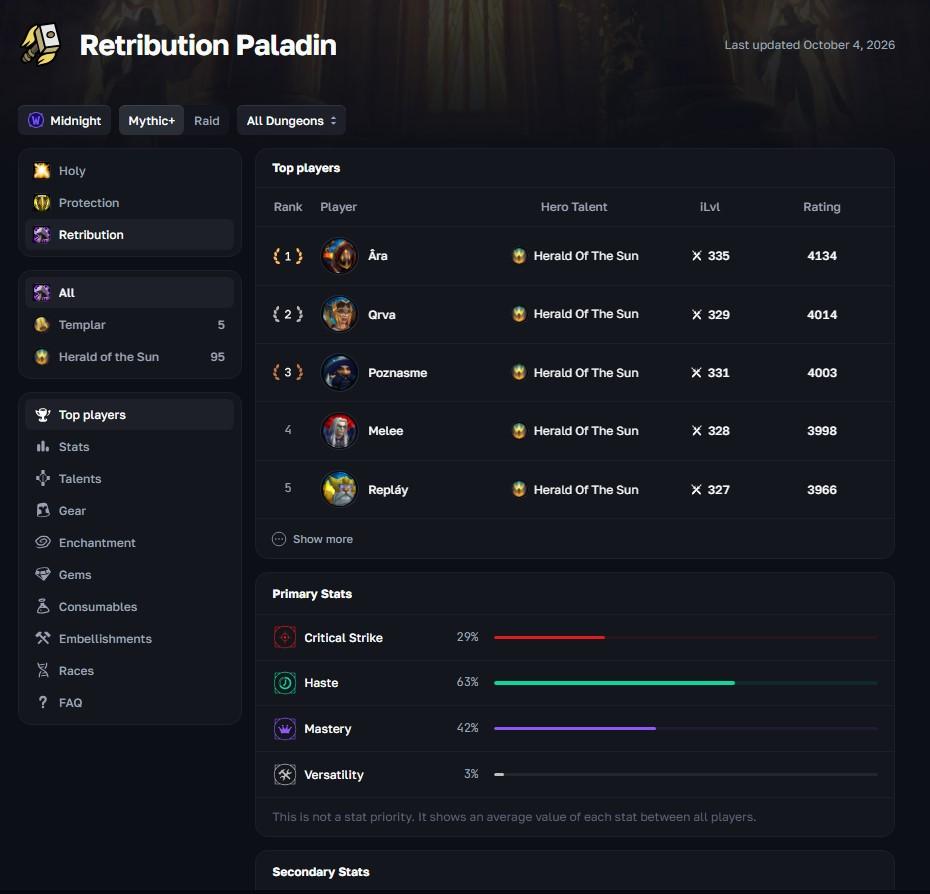
If you want the full picture of the spec, the ret paladin page on WoW.gg goes deeper into the Retribution specialization than we can here. Think of this article as the overview and that page as the place to go for details on talents and rotation.
Holy Power: Where Damage Quietly Disappears
The most common beginner habit is spending Holy Power the instant the minimum is available. It feels busy, but it often leaves you empty exactly when your burst window opens.
A better baseline:
- Check your Holy Power before you press a generator, so you do not overcap.
- Arrive at a burst window with resource banked, not at zero.
- Avoid dumping your last charges on a weak target when a larger one is about to spawn.
One practical fix: make your Holy Power display impossible to miss, either with the default UI or an addon. A lot of lost damage comes from simply not looking at the resource during a fight.
Burst Windows: Setup Matters More Than the Button
Pressing your cooldown at the pull is easy. Knowing when not to is the skill.
Ask yourself three things before using it:
Exact timings differ by patch and encounter, so rely on your own logs rather than memory. Watching how your own pulls went will teach you more than any rule of thumb.
Hero Talents and Build Choices
Retail paladins have hero talent trees that noticeably change how the spec plays. For Retribution, Templar and Herald of the Sun are the options usually discussed. The right pick depends on content:
|
Situation |
What usually matters |
|
Raid, single target |
Steady single-target damage, strong burst |
|
Mythic+, big pulls |
Cleave, pull control, utility |
|
Mythic progression |
Survivability and mechanic handling |
Do not copy a build blindly. The best setup depends on your playstyle, your group and the encounter. Understand what each choice does before you swap it.
Survivability: The Part People Forget
Retribution has its own toolkit for staying alive, and dying in the middle of burst costs far more than a slightly imperfect rotation.
- Divine Shield can save you from lethal mechanics, but it drops threat and pauses your damage. Use it deliberately.
- Lay on Hands is a near-full heal. It is not only a personal button; in tougher keys it is sometimes better saved for an ally.
- Blessing of Protection and Blessing of Freedom shine on other players. Freeing a tank from a root or shielding a healer from physical damage can be worth more than a few percent of damage.
- Hammer of Justice and Rebuke matter a lot in dungeons where stops and interrupts decide whether a pull goes cleanly.
Common Mistakes
- Playing from muscle memory without tracking resource.
- Using the big cooldown on cooldown, ignoring the target.
- Spending Lay on Hands or Divine Shield with no plan.
- Forgetting interrupts and crowd control in keys.
- Copying someone else’s build without understanding it.
- Never reviewing your own logs after a failed pull.
That last one matters most. A single log review will show where you were out of Holy Power, where your burst came late and where you simply died.
Pre-Raid and Pre-Key Checklist
- Build matches the content (raid or Mythic+).
- Holy Power is clearly visible on screen.
- You know when your next burst window is and how long the target will live.
- You know who needs Blessing of Protection or Lay on Hands, and when.
- Interrupts and stuns are assigned if you are in a key.
- Consumables and gear are in order for the content’s item level.
- You have looked at how strong players handle your bosses or dungeons.
A ret paladin wins by thinking a step ahead: resource, burst timing, group utility. Start by getting Holy Power under control, then refine how you set up burst windows, and only after that tune your build. The rest comes with practice and honest review of your own pulls.