
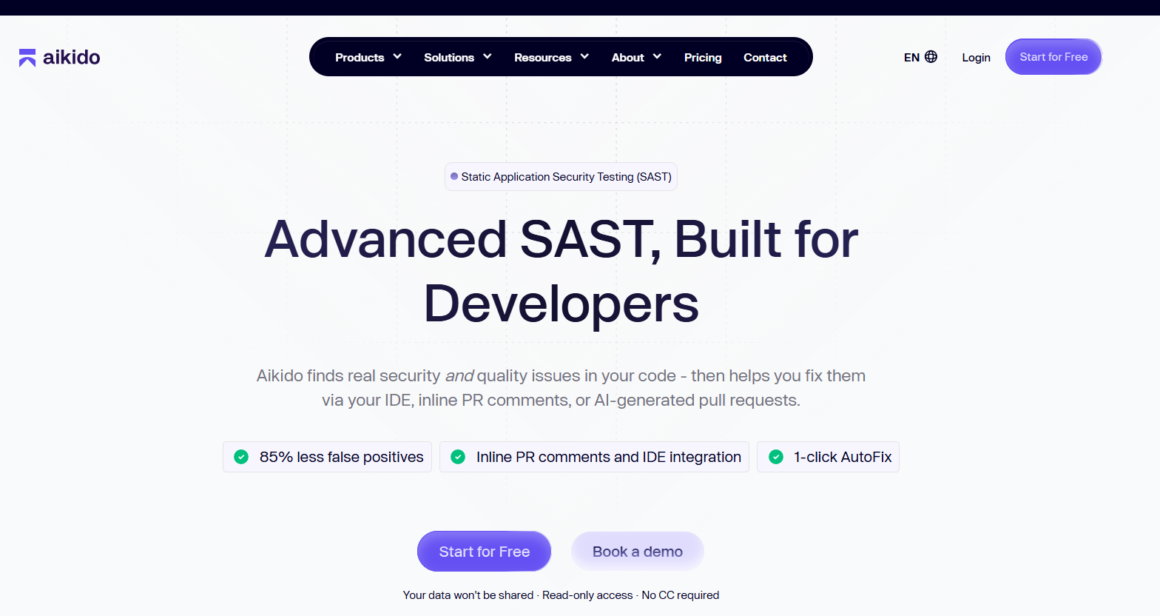
Static analysis is no longer just about scanning source code for vulnerabilities. Modern
development environments move much faster than they did a few years ago.
Development teams now want tools that integrate seamlessly into pull requests, CI/CD pipelines, and daily coding workflows.
This is where the biggest difference between Checkmarx and Aikido Security becomes clear.
The Biggest Difference: Standalone SAST vs Unified AppSec
One major distinction between the two platforms is their philosophy.
Checkmarx is mainly focused on deep static code analysis. It excels in enterprise-scale scanning and governance-heavy environments where security teams manage large scanning workflows.
Aikido Security takes a broader approach by combining SAST with additional security layers, such as:
- Dependency scanning (SCA)
- Secrets detection
- Container security
- Cloud security monitoring
- Infrastructure-as-Code scanning
Instead of using multiple disconnected tools, teams can manage security from a single platform with shared visibility and prioritization.
For many modern engineering teams, reducing the number of tools has become just as important as improving vulnerability detection.
The Developer Checklist for Evaluating SAST Tools
|
Developer Priority |
Why It Matters |
Aikido Security |
Checkmarx |
|
Fast scan results |
Developers want immediate feedback while coding instead of waiting hours for reports. |
Lightweight scans with quick feedback in CI/CD pipelines |
Deep scans can be slower; better suited for scheduled or nightly runs |
|
Low alert noise |
Too many false positives can cause developers to ignore security findings entirely. |
AI-assisted prioritization reduces noise significantly |
Can generate high alert volumes without careful tuning |
|
Clear remediation guidance |
Actionable fixes help teams resolve vulnerabilities faster without extensive research. |
Contextual fix suggestions built into the workflow |
Detailed findings, but guidance can require security team interpretation |
|
CI/CD integration |
Security checks should run automatically inside deployment pipelines. |
Lightweight, developer-friendly integration |
Strong enterprise integration, but it can require a heavier setup |
|
Minimal workflow disruption |
Developers prefer security tools that fit naturally into existing workflows. |
Designed around developer workflows from the ground up |
More security-team oriented; can feel heavyweight for developers |
Aikido Security
Aikido Security is a modern application security platform aimed at development teams looking for broad security coverage without the hassle of juggling multiple disconnected tools.
Instead of just focusing on static analysis, Aikido combines SAST, dependency scanning, cloud security, container security, secrets detection, and Infrastructure-as-Code scanning into a single, developer-friendly platform.
The platform is especially popular with cloud-native teams that want quick feedback, simple workflows, and fewer alerts that overwhelm them.
Pros
- A significant reduction of operational friction
- Risk prioritization, based on contextual analysis and AI-assisted correlation
- Centralized visibility across code, cloud, containers, and dependencies
- Faster remediation with developer-friendly workflows and fix suggestions
- Lower alert fatigue by reducing duplicate and low-priority findings
This helps teams focus on vulnerabilities that are actually exploitable or impactful.
Its broader security coverage eliminates the need for multiple disconnected tools, simplifying workflows for both developers and security teams.
Best for: Organizations that rely heavily on:
- Cloud-native infrastructure
- Kubernetes environments
- Microservices architectures
- Fast CI/CD deployment pipelines
- Smaller security teams managing large workloads
A unified platform often becomes easier to scale operationally.
Checkmarx
Checkmarx is one of the longest-standing SAST platforms in the application security market. Many enterprises use it for in-depth static code analysis, compliance support, and centralized security management.
The platform is recognized for its wide language support and enterprise-level scanning capabilities across large and complex codebases.
Pros
- Strong SAST capabilities
- Deep scanning options suitable for large enterprise environments
- Useful for organizations with complex security requirements
- Offers detailed scanning and reporting options
Best for:
- Large enterprises with established security teams.
- Organizations that need detailed governance and compliance reports.
- Companies managing large and complex codebases.
- Security programs that emphasize deep static analysis.
Its enterprise background continues to make it a trusted option for heavily regulated industries and centralized security environments.
Comparison Table: Checkmarx vs Aikido Security
|
Category |
Aikido Security |
Checkmarx |
|
Core Approach |
Unified application security platform combining multiple security layers in one system |
Traditional SAST-focused platform built primarily around static code analysis |
|
Primary Focus |
Broader AppSec coverage, including code, cloud, dependencies, and infrastructure |
Deep SAST for source code vulnerabilities |
|
Developer Experience |
Designed for developers with simplified workflows and fast, actionable feedback |
More security-team oriented with structured scanning and reporting workflows |
|
Scanning Scope |
SAST, SCA, secrets detection, cloud security, containers, and IaC in one platform |
Strong SAST coverage with additional features depending on the enterprise setup |
|
Cloud-Native Support |
Strong support for modern cloud-native and DevOps environments |
Limited compared to modern unified AppSec platforms |
|
Tooling Model |
Single integrated platform replacing multiple security tools |
Often part of a larger multi-tool security stack |
|
CI/CD Integration |
Lightweight and developer-friendly integration into pipelines |
Strong enterprise CI/CD integration, but it can require a heavier setup |
|
Best For |
Fast-moving DevOps teams, cloud-native applications, and teams seeking tool consolidation |
Large enterprises with mature security governance and compliance requirements |
|
Overall Strength |
Simplicity, speed, and unified visibility across the entire application stack |
Depth of static analysis and enterprise-grade control |
Final Verdict
Both platforms are effective, but they serve different priorities.
Checkmarx is a strong traditional SAST solution with extensive enterprise-grade scanning features and solid governance capabilities.
However, Aikido Security aligns more closely with how modern software teams operate in 2026. Faster feedback, broader AppSec coverage, reduced alert fatigue, and developer-friendly workflows make it a better fit for agile and cloud-native environments.
FAQ
- What is the difference between Checkmarx and Aikido Security?
Checkmarx is mainly a traditional SAST tool focused on deep code scanning, while Aikido Security is a unified AppSec platform that also includes SCA, cloud, containers, and secrets scanning.
- Is Aikido Security better than Checkmarx?
Aikido is often better for modern DevOps and cloud-native teams due to faster workflows and broader coverage, while Checkmarx is stronger for enterprise-grade SAST and compliance use cases.
- Does Checkmarx only do SAST?
Checkmarx is primarily focused on SAST, but it can be part of a larger enterprise security setup with additional tools for full coverage.
- Why choose Aikido Security?
Aikido Security provides a single platform for multiple security areas, reducing tool sprawl and giving developers faster, clearer feedback.
- Which is better for DevOps teams?
Aikido Security is generally better suited for DevOps teams because it integrates more smoothly into CI/CD pipelines and supports cloud-native workflows.